

Retreading as a concept makes sense on many different levels.
First, you take a high-quality tire carcass and extend its life from perhaps 100,000 km to more like 500,000 or even more- as much as 700,000 is a reasonable goal.
That means more rubber compound that does not have to be mixed, cooled, extruded and formed into a tire, saving time, materials, energy, emissions- all those factors we are trying to manage down, in the interests both of the environment and hard-nosed economics.
Second, you cut the cost of use to fleet operators, enabling them to make their essential investments go further and achieve higher levels of efficiency. Given the current crisis in energy costs, which will probably lead to a long-term reset, this is a major benefit for retreading.
Yet the industry is still under pressure from some quarters. Making retreads is traditionally seen as a difficult, labor intensive and dirty process. That’s why VMI has a long-term strategy for retreading. We are using some of the same automation techniques that we used to transform new tire building into retreads, as well.
This approach is changing the appeal, economic realities and environmental performance of retreading, stage by stage.
How it works
In concept, retreading is a simple business. First, you strip the old tread from the carcass, inspect and then fix any flaws in the casing. Second, you apply a new tread, onto the carcass and splice it. Third, you prove and condition the retread to make it ready for use.
In between you have the need to place carcasses onto a rail for transport to the extruder, apply cushion gum to the carcass and add the new tread, then reload the tire back onto the rail for moving to the next stage.
The big issue has always been that the work is highly dependent on skilled human labor. And that is a problem, these days, because it is getting harder to find the right people with the right skills and dedication to do this job. Working conditions are tough and pollution levels are high.
So how to change the nature of the work?
The next stage of automation
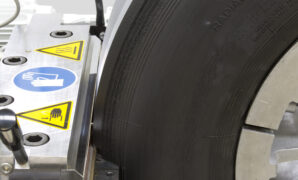
VMI’s automated splicer is the answer. At this, the most highly skilled and difficult part of the process, human interaction is virtually eliminated. The skilled operator no longer needs to fit the new tread, bring the ends together, make sure everything is correctly in place and then hand splice the tread…
Now this process is fully automated. The operator’s task is to place the carcass and new tread into position and activate a fully machine-driven automatic splicing mechanism. The benefits are very clear.
It’s more accurate, it’s consistent, quality of output does not vary, depending on the capability or energy levels of a human operator. It’s always right, always done in the exact same way, always leading to a predictable- and predictably high quality- outcome.
For retreading companies, this is a game changer. Seeing is believing, and at The Tire Cologne, in June 2026, we will be displaying the Auto Splice Unit on our stand. This is the industry’s chance to see another VMI breakthrough and consider what this could mean for their business.
This is not the end of the story: it’s just one step towards complete end to end automation of the retreading process. It does have the potential to save time and money, improve quality and enhance environmental performance.
If this topic is important to you, come and talk to the VMI team in Cologne 9th to 11th June. Please fill out the form below to set up a meeting on our stand or have a first discussion.